New Features for Omatic Cloud: March 2026


Content Marketing Manager
In this month’s product update, we’re introducing some exciting enhancements designed to help teams unify data across tech stacks and solve transformation challenges without sacrificing accuracy or time.
First, Omatic’s new Shopify connector marks our entry into ecommerce connectivity, automatically bringing sales transactions into the CRM for better stewardship, reporting, and financial reconciliation. Second, our Custom Code Transformation feature gives technical users greater flexibility to handle edge cases standard transformation features can’t address. Finally, we now support UK Gift Aid (Tax) Declarations so UK-based organizations can create and manage required declaration fields within integration workflows. All together, these updates reflect our goal: to help nonprofits unify data and use it to power their missions.
Get the full scoop on our latest product releases.
Nonprofits are increasingly using Shopify to support merchandise sales, memberships, digital goods, and event-related purchases—creating new revenue streams that have become a vital part of nonprofit fundraising. But too often, Shopify data remains siloed from the CRM. That disconnect makes it harder to steward customers like traditional supporters, reconcile revenue, and understand how commerce fits into the full engagement lifecycle.
With Omatic Cloud’s new Shopify connector, organizations can automatically connect ecommerce activity to their CRM—ensuring every purchase, refund, tag, and preference becomes a trusted signal for engagement, reporting, and stewardship.
Read on to learn how this new connector will be a gamechanger for your data strategy.
When Shopify customers live only in your storefront database, you’re left with incomplete records and manual imports. Omatic Cloud’s latest connector automatically brings clean, consistent customer data into your CRM, connecting names, contact details, communication preferences, and purchase history to existing supporter records, tailored to your organization’s data conventions.
The result? A unified view of each supporter across fundraising and commerce channels. Teams can identify repeat buyers, high-value purchasers, or membership holders—and bring them the fold for targeted stewardship opportunities.
Accurate reporting depends on complete transaction data. Omatic Cloud maps Shopify orders, line items, payments, refunds, and adjustments into the CRM in a consistent format.
No more reconciling spreadsheets or using partial integrations that miss valuable data. Refunds, returns, and cancellations are automatically reflected in CRM records, preserving financial integrity, and keeping purchase histories up to date.
A merchandise or ticket purchase is more than just a transaction, it’s a sign of interest in your organization. With real-time CRM updates, teams can trigger segmented follow-up based on purchase behavior:
Purchases often reflect highly engaged supporters who may never make a traditional donation. By capturing these transactions as structured CRM records, organizations uncover donor prospects they might otherwise overlook.
Beyond engagement, financial accuracy matters for nonprofit organizations. Shopify revenue, refunds, discounts, and fees flow cleanly into the CRM and can be connected to an accounting system. Finance leaders gain a fully auditable, reportable path from checkout through close, without disconnected systems or manual reconciliation.
Ready to bring Shopify data into your CRM? Get a demo of our latest connector today!
Sometimes organizations run into unique edge cases that Omatic Cloud’s standard data transformation capabilities simply can’t solve. Complex formatting. Tricky conditional logic. When those scenarios occur, teams rely on manual cleanups or workarounds that introduce risk to data integrity.
The new Custom Code Transformation feature in Omatic Cloud gives technical users an option to apply JavaScript directly within their integration workflows—so data lands in the destination system according to exact specifications automatically.
Custom Code Transformations allow advanced users to:
Instead of waiting for new product functionality, teams can solve one-off transformation needs while maintaining full visibility and control.
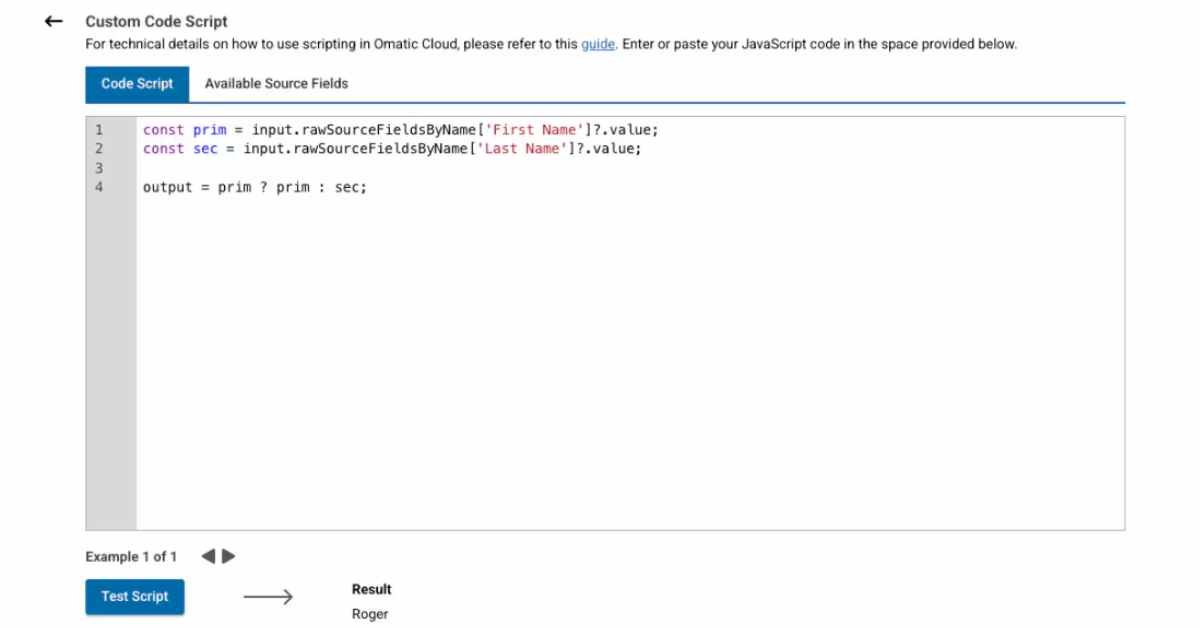
This feature is designed for experienced developers who are comfortable working in JavaScript. It provides a custom scripting opportunity within Omatic Cloud, but the responsibility for designing, testing, and maintaining custom scripts remains with the organization. Please note: because Omatic won’t provide support for errors caused by custom code transformations, we recommend rigorous testing before and after using this feature.
In the hands of an expert, Custom Code Transformations unlock flexibility without sacrificing integration stability.
Here are some scenarios where custom code transformations can come in handy:
1. Smart Field Selection & Fallback Logic: Automatically use a primary value when present, otherwise fall back to an alternate (e.g., primary vs. secondary email). This improves data completeness without manual review.
2. Numeric Cleanup & Calculations: Remove currency formatting, standardize numeric values, and perform calculations during processing, for faster financial reporting and fewer reconciliation complications.
3. Layered Business Logic: Reference the output of one transformation to prompt another. For example, assign a donor tier based on gift amount, then use that tier to trigger segmentation or campaign assignments.
4. Nested & Child Data Structures: Access and transform child records or related objects, allowing for deeper control over complex data structure.
5. Text Standardization: Create consistency for phone numbers, IDs, casing, or abbreviations before data reaches the destination system, reducing future errors and cleanup.
—
Custom Code Transformations help organizations handle the final layer of complexity that holds teams back from having unified data in a CRM. For technical teams capable of managing sophisticated integrations, it delivers more flexibility, control, and confidence in your data than ever.

Gift Aid declarations are critical to unlocking additional funding and meeting HMRC compliance requirements. When tax declaration data is missing, misaligned, or inconsistently mapped, organizations risk losing reclaimable revenue or introducing compliance gaps that require manual correction.
With Omatic Cloud’s support for UK Gift Aid (Tax) Declarations, organizations can create and manage required declaration fields directly within their integration workflows. As data flows into Blackbaud Raiser’s Edge NXT, Omatic Cloud ensures the necessary declaration details are mapped and structured correctly so that declarations are created accurately, compliance requirements are met, and teams avoid unnecessary manual fixes.
With Omatic Cloud’s UK gift aid declaration functionality, you can:
Omatic Cloud makes it easy to apply consistent formatting rules to your data, so it’s clean, accurate, and ready for use across systems.
Sign up to receive our e-newsletter with the latest tips, technology, trends, and upcoming events.


